How to Fix Salt Damage on Grass Near Driveways and Sidewalks?
Patches near the sidewalk look scorched and lifeless. The rest of the yard is waking up just fine but those edges look dead. That is salt damage and it is one of the most common spring frustrations for homeowners in cold climates.
The good news is that salt damaged grass can recover. You do not need a professional. You do not need expensive products. You need the right steps in the right order.
This guide will walk you through every stage of fixing salt damage. You will learn how salt hurts your grass, how to flush it out, how to rebuild your soil, and how to stop it from happening again next winter.
Key Takeaways
- Salt damage happens when sodium from deicing products builds up in the soil near paved surfaces, pulling moisture away from grass roots and causing dehydration even when the soil is wet.
- The fastest repair method involves three core steps: flushing salts out with deep watering, applying pelletized gypsum to displace sodium from soil particles, and then overseeding bare spots with salt tolerant grass varieties.
- Water alone often is not enough for heavy damage. Gypsum replaces sodium with calcium and sulfur, which frees the salt to be washed deeper into the ground where roots cannot reach it.
- Some grass types handle salt much better than others. Perennial ryegrass, tall fescue, and fine fescues survive salty edges far better than Kentucky bluegrass, which is very sensitive to sodium.
- Prevention is simpler than repair. Use less deicer, shovel snow before it turns to ice, and create a small buffer strip of mulch or stone between your lawn and paved surfaces to catch salt before it hits your grass.
What Is Salt Damage and Why Does It Happen
Salt damage on grass is not a disease or a pest problem. It is a chemical injury caused by deicing products that we spread on driveways, sidewalks, and roads during winter. The most common deicer is rock salt, also known as sodium chloride. Municipal plow trucks dump tons of it on roads. Homeowners spread it on walkways and driveways. It works well for melting ice. But it does not stay on the pavement.
When snow melts in late winter and early spring, the salty water flows off the hard surfaces and into the soil along the edges. Plows push salty slush onto grass strips near the curb. Snow blowers spray salt laden snow several feet into your yard. Passing cars kick up a fine salt mist that can travel up to 150 feet from the road. All of this salt ends up in your soil.
Once there, the sodium starts causing problems. It does not break down. It does not evaporate. It sits in the soil and builds up year after year. The damage you see in spring is often the result of salt applied months earlier. The worst spots are always the edges closest to pavement because that is where salt concentrations are highest. Understanding this pattern is the first step toward fixing it.
How Salt Actually Hurts Your Grass
Salt damages grass in three distinct ways. First, it causes dehydration through a process called osmotic stress. Normally, grass roots pull water from the soil into the plant. Salt reverses this process. High salt levels in the soil pull moisture out of the grass roots instead.
The result is called physiological drought. Your soil can be soaking wet and your grass can still die of thirst. The blades turn brown and crispy. They look burned.
Second, sodium displaces essential nutrients in the soil. Soil particles naturally hold onto nutrients like potassium, calcium, and magnesium. These nutrients have a positive charge that binds to the negatively charged soil particles.
Sodium also has a positive charge and it competes for those same binding spots. When sodium wins, it kicks out the good nutrients. Your grass roots cannot find the potassium they need for strong cell walls. They cannot access calcium for root development.
Third, salt breaks down soil structure over time. Healthy soil has tiny air pockets that allow water to drain and roots to breathe. Salt causes soil particles to disperse and collapse. The soil becomes dense and compacted. Water cannot drain through it.
Roots cannot push through it. This creates a cycle of poor health. Compacted soil traps even more salt near the surface, which kills more grass, which leaves more bare soil, which compacts even further. Breaking this cycle requires deliberate action.
How to Identify Salt Damage on Your Lawn
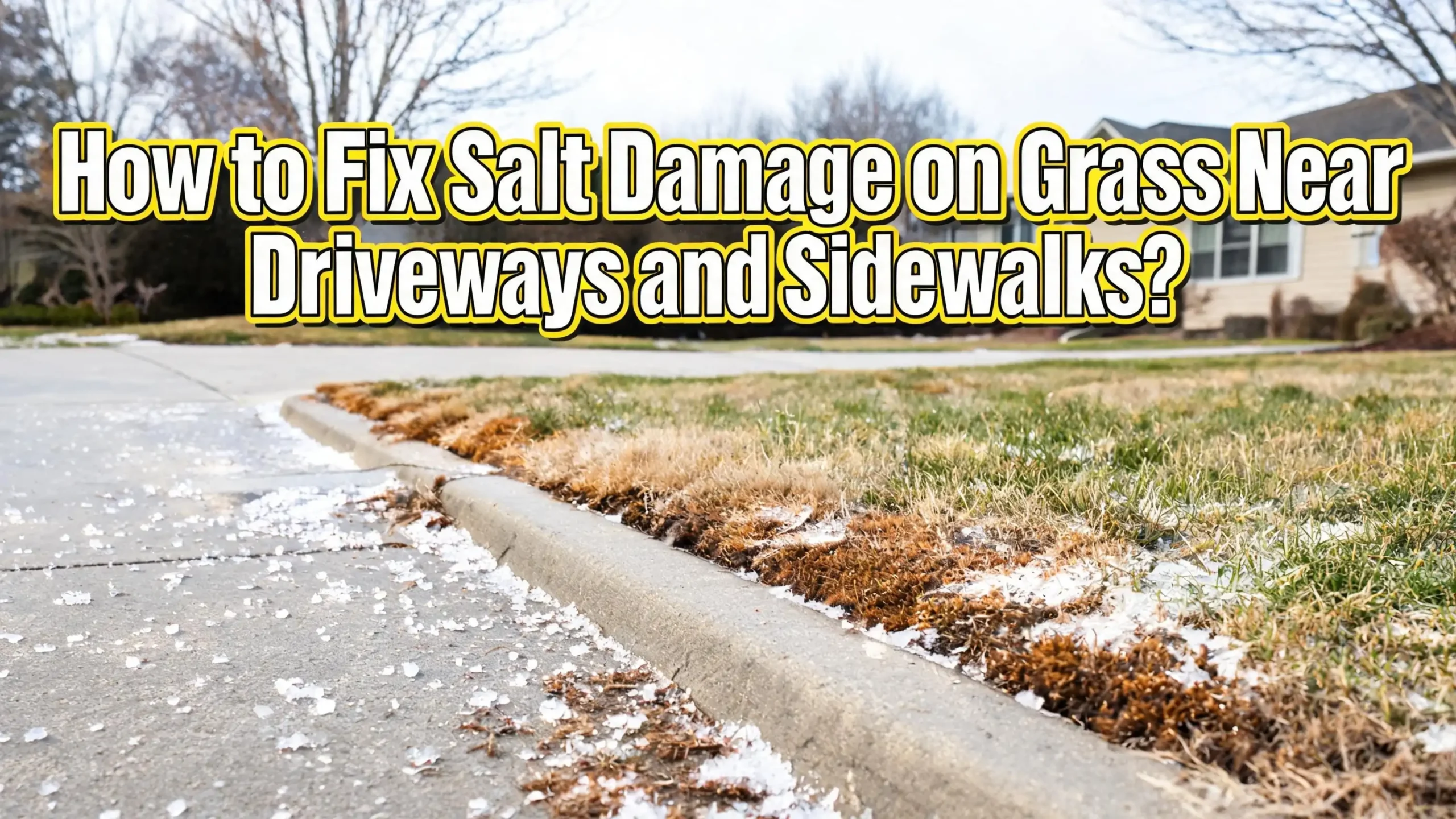
Salt damage has a very specific look and pattern. It almost always appears in narrow bands along the edges of driveways, sidewalks, curbs, and roads. The damage is worst within the first few feet of the pavement and slowly gets better as you move into the yard.
You will see straw colored or bleached looking grass that looks scorched. The transition from dead grass to healthy grass is often sharp and straight like someone drew a line.
You may also see a white or gray crust on the soil surface. This is dried salt residue left behind after meltwater evaporates. Another clue is delayed green up in spring. While the rest of your lawn wakes up and turns green, the salty edges stay brown and dormant for weeks longer.
Some grass may appear thin and stunted instead of fully dead. The crowns might still be alive but too weak to push out healthy growth.
Do not confuse salt damage with other common spring problems. Dog urine spots are round and scattered randomly. Snow mold creates matted grayish circles across the lawn. Dormancy makes the whole lawn brown evenly.
Salt damage is directional and location specific. It hugs the pavement. If the pattern matches where snow piles sat or where meltwater flows, you are almost certainly looking at salt injury. A simple soil test can confirm elevated sodium levels if you want to be certain before you start repairs.
Step One: Flush the Salt Out of the Root Zone
The first and most important repair step is flushing salt out of the soil with fresh water. This process is called leaching. Salt is water soluble, which means it dissolves and moves with water.
Your goal is to push the dissolved salt deep into the ground below the root zone of your grass. Grass roots typically reach about four to six inches deep. If you can move the salt below that depth, your grass gets instant relief.
Use a garden hose with a shower or rain style nozzle setting. You want gentle, even water distribution without so much force that it washes away soil. Soak the affected area heavily until water starts to pool on the surface. Let it soak in completely. Then do it again. Repeat this cycle three to four times in a single session. This is not a light sprinkling. You are trying to move water deep into the soil profile.
Research from Colorado State University confirms that six inches of water can reduce soil salt levels by about fifty percent. Twelve inches of water, or one foot, can reduce salt levels by eighty percent. Two feet of water can achieve ninety percent reduction. These numbers show why deep watering matters so much. A quick spray with the hose will not cut it.
Pros of the water flushing method: It is free, simple, requires no special products, and works immediately on water soluble salts. Cons: It uses a lot of water, does not work well on heavily compacted soil, and sodium that is bound to soil particles will not flush out with water alone. You may need gypsum for the next step.
Step Two: Apply Gypsum to Displace Stubborn Sodium
Water flushing removes the loose salt dissolved in the soil solution. But a significant portion of sodium is stuck to the soil particles themselves. This bound sodium will not wash away with water alone. You need something to knock it loose. That something is gypsum, which is calcium sulfate.
Gypsum works through a simple chemical swap. The calcium in gypsum has a stronger attraction to soil particles than sodium does. When you apply gypsum and water it in, the calcium pushes the sodium off the soil particles and takes its place.
The now freed sodium combines with the sulfate from the gypsum to form sodium sulfate. Sodium sulfate dissolves easily in water. Now you can flush it away with another round of watering.
Spread pelletized gypsum over the affected areas using a standard lawn spreader. The recommended rate is about twenty to forty pounds per one hundred square feet. Make two passes at half rate in opposite directions for even coverage.
This is not a product you need to be afraid of over applying within reason. Gypsum does not change soil pH and it does not burn grass. It simply adds calcium and sulfur, both of which are plant nutrients.
Step Three: Leach Again to Remove Sodium Sulfate
After you apply gypsum and water it in thoroughly, you need to flush the soil once more. This second leaching round washes away the newly formed sodium sulfate. The process is the same as the first flush. Use your garden hose on a gentle setting. Soak the area until water pools. Let it drain. Repeat several times.
This step is easy to skip because it feels redundant. Do not skip it. If you leave the sodium sulfate in the root zone, it will eventually separate back into sodium and sulfate ions. The freed sodium will reattach to soil particles and you will be back where you started. The whole point of applying gypsum is to free the sodium so you can wash it away permanently. Finish the job.
Give the area a day or two to dry out after this second flush. You do not want to work on muddy soil for the next steps. The ground should be moist but not soggy. If you squeeze a handful of soil and water drips out, it is too wet. Wait for better conditions before you move on to raking and reseeding.
Step Four: Rake Out Dead Grass and Prepare the Soil
Now you need to clear the way for new growth. Dead grass will not come back to life. Leaving it in place blocks sunlight, traps moisture against healthy grass, and prevents new seeds from making contact with the soil. Use a leaf rake or a garden rake and work gently over the damaged areas.
Be careful not to rake too aggressively. The goal is to remove dead, brown, straw like material without tearing out grass crowns that might still be alive. A grass crown is the small white base at the soil surface where roots meet blades.
If the crown is still firm and white or light green, that grass plant can recover. Leave it alone. Only remove material that is clearly dead, dry, and pulls away with almost no resistance.
After raking, rough up the top half inch to one inch of soil in any fully bare spots. A hand cultivator or a stiff rake works well for this. You are creating a slightly loose surface that seeds can settle into.
This step also breaks up any surface crust that formed from the salt and watering cycles. Good seed to soil contact is essential for germination. Seeds sitting on top of hard crusted soil will dry out and die.
Step Five: Topdress Bare Areas with Quality Material
Topdressing means spreading a thin layer of material over the soil surface before you seed. It protects seeds, holds moisture, and improves the soil that your new grass will grow in. The best topdressing materials for salt damaged areas are screened compost, a mix of sand and compost, or topsoil that matches your existing soil type.
Do not use pure sand unless your lawn already grows in sandy soil. Do not use heavy clay soil over sandy ground. A mismatch between your topdressing and your underlying soil creates a distinct layer that blocks water and air movement. Grass roots will struggle to cross from one soil type into another. This is a common mistake that leads to poor results.
Spread one quarter to one half inch of topdressing material over the bare spots. Use the back of your rake to level it out. You want enough material to cover seeds lightly but not so much that it smothers existing grass at the edges. Water the topdressing lightly to settle it before you spread seed.
Pros of topdressing: It improves soil organic matter, buffers against future salt exposure, holds moisture for germinating seeds, and speeds up soil recovery. Cons: It adds cost and labor, requires you to source quality material, and poor material choice can create drainage problems.
Step Six: Overseed with Salt Tolerant Grass Varieties
Now you are ready to plant new grass. Choose your seed wisely. The grass that died from salt damage was probably not salt tolerant. If you reseed with the same variety, you will face the same problem again. Salt tolerant grasses give you a permanent advantage in the battle against winter deicer damage.
For cool season lawns, the best salt tolerant choices are perennial ryegrass, turf type tall fescue, and fine fescues like creeping red fescue. Perennial ryegrass germinates fast, usually within five to seven days, and handles moderate salt levels well.
Tall fescue has deep roots and excellent drought and salt tolerance. Fine fescues are the most salt tolerant cool season option and work especially well in shady areas near driveways.
For warm season lawns, Bermudagrass and St. Augustinegrass offer good salt tolerance. Seashore paspalum is extremely salt tolerant but only suitable for coastal or very warm regions. Kentucky bluegrass is the worst choice for salt exposed edges. It has low salt tolerance and consistently fails in these high exposure zones.
Spread seed at the rate recommended on the package for new lawns or overseeding. Use a handheld spreader for small patches or a walk behind spreader for longer strips. After spreading, lightly rake the seed into the topdressing so it has good contact with the soil.
Then water gently with a fine mist setting. Keep the seeded area consistently moist until germination happens. This may mean watering lightly two or three times per day in warm weather.
Step Seven: Water and Care for New Grass Properly
The first two weeks after seeding are critical. New grass seeds must stay moist at all times to germinate. Once they sprout, the tiny roots are shallow and vulnerable. If the soil surface dries out for even a few hours, those seedlings can die. Water lightly and frequently during this phase. A fine mist or gentle spray works best. Avoid heavy streams that wash seeds away.
After the grass reaches about two inches tall, you can start reducing watering frequency and increasing the amount per session. This encourages roots to grow deeper. Deep roots make your grass more resilient against future salt exposure, drought, and foot traffic. Gradually shift from daily light watering to watering every two or three days with more volume.
Do not mow new grass until it reaches at least three to four inches tall. The first mowing should remove no more than one third of the blade height. Sharp mower blades are especially important for young grass.
Dull blades tear the tender blades and create openings for disease. Hold off on fertilizer for the first four to six weeks. The topdressing compost and the starter fertilizer you may have mixed with your seed provide enough nutrition for early growth.
Should You Replace Soil Completely for Severe Damage
Some salt damage is too severe for flushing and reseeding. If you have tried the steps above and new grass will not grow, or if the affected soil has a thick white crust that reappears after watering, you may be dealing with extreme salt accumulation. In these cases, removing and replacing the top several inches of soil is the best option.
Dig out the affected soil to a depth of four to six inches. Dispose of it somewhere that will not harm other plants. Fill the excavated area with fresh clean topsoil mixed with compost. Grade it to match the surrounding lawn. Then seed or sod as normal. This is a dramatic fix but it works when nothing else will.
Pros of soil replacement: It removes the problem completely, gives you a fresh start, and eliminates years of accumulated salt in one afternoon. Cons: It is labor intensive, costs money for new soil, creates disposal challenges, and disrupts the lawn more than any other method. Reserve this approach for the worst cases.
How to Prevent Salt Damage Next Winter
Prevention is always better than repair. The best way to stop salt damage is to use less salt near your lawn in the first place. Start by shoveling snow early and often. Clear snow before it gets packed down and turns into ice. Bare pavement needs far less deicer than ice covered pavement. This simple habit reduces your salt use by fifty percent or more.
When you do apply deicer, use a light hand. Most people spread far more salt than needed. A tablespoon per square meter is enough. You should still see pavement between the salt granules. Piles of salt mean piles of dead grass in spring. Sweep up any excess salt after the ice melts. Do not wash it into your lawn with a hose. Dispose of it in the trash.
Choose better deicing products when possible. Calcium magnesium acetate, or CMA, is a much safer option for grass, concrete, and pets. Calcium chloride and magnesium chloride are less damaging than sodium chloride but still pose some risk. Sand, kitty litter, or gravel provide traction without any chemical damage. They do not melt ice but they reduce slipping.
Create a physical buffer between your lawn and paved surfaces. A strip of mulch, decorative stone, or low growing shrubs along the driveway and sidewalk catches salt before it reaches your grass. This buffer only needs to be twelve to eighteen inches wide. It solves the problem permanently by putting distance between the salt source and your turf.
Understanding Soil Drainage and Its Role in Salt Problems
Soil drainage plays a huge role in how much salt damage your lawn suffers. Well drained soil allows water to move through it freely. Salt flushes out naturally with rain and snowmelt. Poorly drained soil traps water near the surface.
Salt stays right where it can hurt grass roots. If your lawn edges have compacted clay soil with standing water in spring, you have a drainage problem that makes salt damage worse.
Core aeration is the best tool for improving drainage in compacted lawn edges. A core aerator pulls small plugs of soil out of the ground, leaving holes that allow water, air, and nutrients to penetrate deeper. Aerate the salt damaged strips and the healthy grass immediately next to them. The holes from aeration become channels that help flush salt downward during watering.
For severe drainage issues, you may need to regrade the area. The goal is to slope the soil slightly away from your lawn edges so salty meltwater flows somewhere else. Even a small grade change makes a big difference.
Consider installing a simple French drain or gravel trench along the pavement edge if water pools there regularly. These drainage solutions are more work up front but they solve the salt problem at its root cause.
Pros of improving drainage: It helps your entire lawn health, reduces future salt buildup without chemicals, and lasts for years. Cons: Core aeration requires equipment rental or hiring a service, regrading is labor heavy, and drainage installations cost money and time.
Choosing the Right Grass for Salt Prone Edges
If you keep reseeding the same edge strips every spring, your grass choice is part of the problem. Some grass species simply cannot handle the salt levels that accumulate near pavement. Switching to a more tolerant variety is the smart long term fix.
The University of Minnesota turfgrass program tested multiple species for salt tolerance. Tall fescue and perennial ryegrass consistently maintained the highest green cover and lowest stress levels when exposed to salt.
Colorado State University data shows that Kentucky bluegrass tolerates salt levels only up to three to six millimhos per centimeter. Perennial ryegrass handles eight to ten. Tall fescue also handles eight to ten. Fine fescues can tolerate up to twelve. Alkaligrass tolerates twenty to thirty, which is extremely high.
This data tells a clear story. If you have Kentucky bluegrass dying along your driveway while the rest of the lawn looks great, the grass itself is the weak link. Overseed those strips with a tall fescue or perennial ryegrass blend next time.
The new grass will not look identical to Kentucky bluegrass. Tall fescue has a slightly wider blade. Perennial ryegrass has a fine texture. But a living mixed strip looks far better than a dead uniform one.
The Role of Organic Matter in Salt Recovery
Organic matter is your lawn’s secret weapon against salt damage. Compost, well rotted leaves, grass clippings, and other organic materials improve soil in several ways that directly fight salt problems.
Organic matter loosens heavy clay soils, which improves drainage and lets salt flush away. It feeds beneficial soil microbes that help break down soil crusts. It also buffers the soil chemistry so sodium spikes do not hit grass roots as hard.
Add a thin layer of finished compost over salt damaged areas after you rake but before you seed. A quarter inch is plenty. Do not bury your existing grass. Work the compost lightly into the top inch of bare soil with a rake.
The compost will hold moisture for your new seeds and slowly release nutrients as it breaks down. Over the growing season, earthworms and soil organisms will pull that organic matter deeper into the soil profile, improving the entire root zone.
Organic matter also helps with the cation exchange capacity of your soil. This is the soil’s ability to hold onto nutrients and buffer against chemical changes. Higher organic matter means more binding sites for potassium, calcium, and magnesium.
It also means fewer open spots for sodium to grab onto. Building organic matter is a slow process but it creates lasting protection against all kinds of soil stress, salt included.
When to Call a Professional for Salt Damage
Most salt damage cases are fixable with the DIY steps in this guide. But some situations call for professional help. If you have large areas of dead grass along a long driveway or an entire roadside frontage, the scale of the project may be too big for hand tools and a garden hose.
Professionals bring truck mounted sprayers for gypsum application, commercial aerators, and bulk quantities of topdressing and seed.
If you have tried flushing, gypsum, and reseeding with no results, the problem may be deeper than surface salt. High water tables can pump salt upward into the root zone continuously. Buried construction debris can create toxic soil pockets.
Utility lines may have altered drainage patterns. A professional lawn care service or landscaping company can diagnose these hidden issues that a homeowner might miss.
Soil testing through a professional lab is another service worth paying for. A standard soil test measures pH, nutrients, and organic matter. A test for soluble salts and sodium adsorption ratio gives you exact numbers on how bad your salt problem really is.
This data removes the guesswork. You will know exactly how much gypsum to apply and how much water is needed to flush the salts out. Most county extension offices offer affordable soil testing and can recommend local labs.
Common Mistakes to Avoid When Fixing Salt Damage
Skipping the water flushing step and going straight to seeding is the most common mistake. Seeds cannot germinate in salty soil. You waste time and money throwing seed onto ground that will not support life. Always flush first.
Using the wrong grass seed is another frequent error. Kentucky bluegrass seed is cheap and widely available. It also cannot handle salt. Spending a few extra dollars on tall fescue or perennial ryegrass seed for your edge strips pays off year after year.
Applying gypsum without watering it in heavily wastes the product. Gypsum needs water to dissolve and carry the calcium into the soil where it can work. Dry gypsum sitting on the surface does nothing for your soil chemistry.
Raking too hard and destroying live grass crowns turns a recoverable area into a bare patch that needs full renovation. Be gentle. Give grass a chance to show you if it can recover before you rip it out.
Ignoring the drainage issue and treating only the symptoms means you will repeat this whole process every spring. Fix the water flow problem and you fix the salt problem permanently.
Frequently Asked Questions
Will grass grow back on its own after salt damage?
Sometimes yes, sometimes no. Mildly affected grass with intact crowns can recover on its own once spring rains flush some salt away. You will see new green shoots emerging from brown clumps within two to three weeks of warm weather. But grass that is completely brown, brittle, and pulls out easily is dead and will not return. Heavy salt accumulation kills roots and crowns. These areas need reseeding. Waiting and watching for a few weeks is smart before you decide what to do.
How long does salt stay in the soil?
Salt does not break down or evaporate. It stays in the soil until water moves it away. In well drained soil with regular rain, salt levels can drop significantly within a few weeks. In heavy clay or compacted soil with poor drainage, salt can persist for months or even years. This is why flushing with your garden hose is so important. You speed up a process that nature does slowly.
Is gypsum safe for pets and children?
Yes, gypsum is completely safe. It is a natural mineral made of calcium and sulfate. It is used in food products, agriculture, and construction. It will not burn skin, harm animals, or contaminate water. You can let pets and children onto treated areas immediately after application. Just water it in well so the fine particles do not get tracked into your house.
What is the best ice melt to use near grass?
Calcium magnesium acetate is the safest option for grass, concrete, and pets. It contains no sodium chloride and breaks down naturally in the environment. Calcium chloride and magnesium chloride are better than rock salt for grass but can still damage concrete. Sand and kitty litter provide traction without any chemical risk but do not melt ice. The best approach is to clear snow quickly so you do not need much ice melt at all.
Can I use vinegar or other home remedies to fix salt damage?
No. Vinegar and other acidic household products will not remove salt from soil. Vinegar adds acetic acid, which can actually stress grass further. Stick with water and gypsum. These are the only proven methods for soil salt remediation. Home remedies for salt damage are mostly myths and can make the problem worse.
How much water do I really need to flush salt out?
A lot more than you think. A quick five minute spray with the hose does almost nothing. You need to soak the soil deeply enough that water moves several inches down. For a ten foot by two foot strip along a driveway, plan to spend at least thirty to forty five minutes with the hose, soaking, waiting, and soaking again. A soaker hose left running for several hours works even better because it delivers water slowly and deeply without runoff. Think in terms of filling the soil like a sponge, not rinsing a surface.

Hi, I’m Jane! As a passionate gardener and product enthusiast, I spend my days testing garden tools, comparing products, and writing honest reviews so you don’t have to learn the hard way. Got a question? Feel free to reach out — I’d love to hear from you!