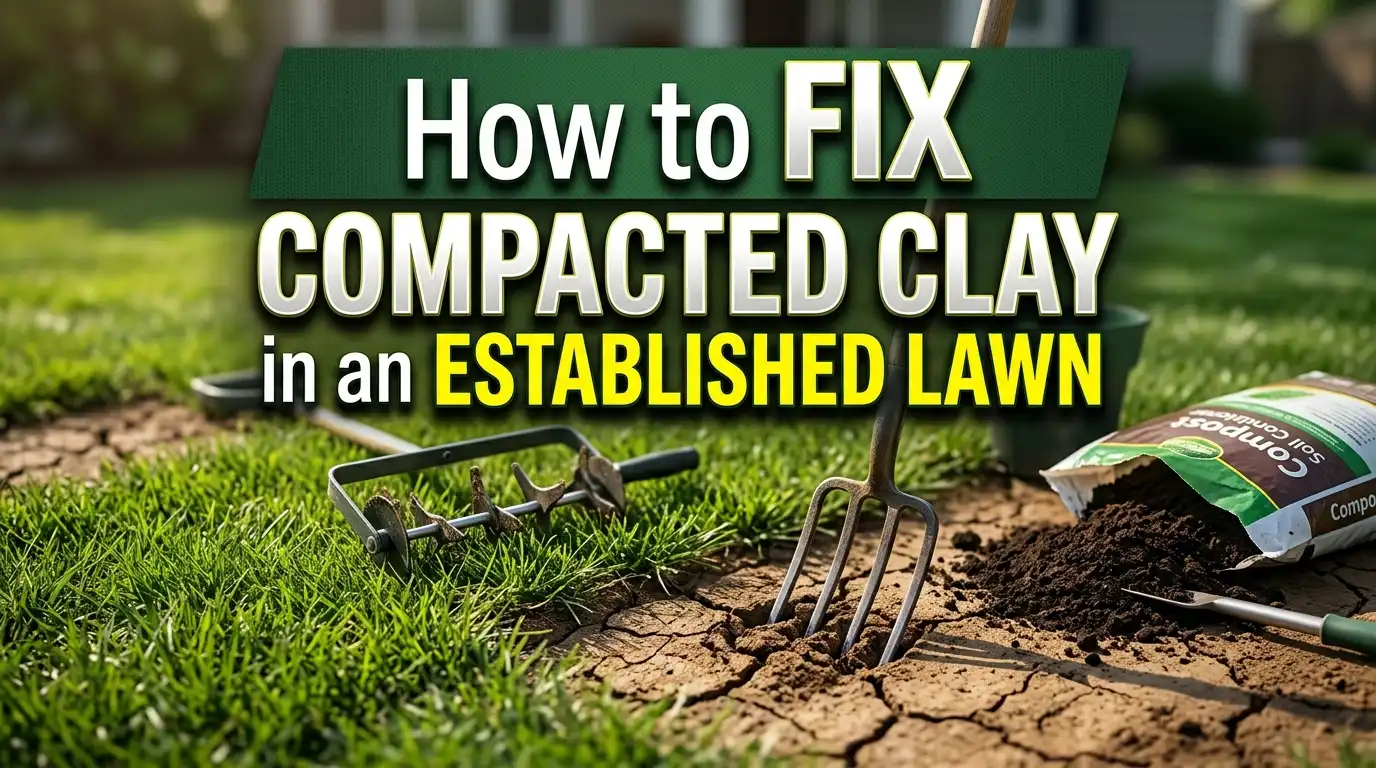
How to Fix Compacted Clay Soil in an Established Lawn?
If your lawn feels like a parking lot under your feet, you are probably dealing with compacted clay soil. Water pools on the surface after every rain. Grass roots struggle to push through the dense, tight ground. Bare patches appear where healthy turf should grow. The problem is real, and it gets worse over time if you ignore it.
The good news? You do not need to tear up your entire lawn to fix this. You can improve compacted clay soil while keeping your existing grass intact. Thousands of homeowners deal with this exact issue, and the solutions are surprisingly straightforward.
This post will walk you through practical, proven methods to loosen that stubborn clay and bring your lawn back to life. Every technique here works on established lawns, so you can start improving your soil this season without starting from scratch.
In a Nutshell
- Compacted clay soil starves your lawn of air, water, and nutrients. But fixing it does not require a complete lawn renovation. Here are the key points you need to know before diving into the full guide:
- Core aeration is the single most effective first step for breaking up compacted clay soil in an established lawn. A core aerator pulls out small plugs of soil, creating channels for air, water, and roots to move freely.
- Topdressing with compost after aeration dramatically speeds up improvement. The organic material fills the aeration holes and begins breaking down clay particles over time. A quarter inch layer of quality compost can make a noticeable difference in just one season.
- Liquid aeration works best as a supplement, not a replacement. It can help with mild compaction and improve soil biology, but it does not match core aeration for severely compacted clay.
- Gypsum is not a magic fix for all clay soils. Research from Purdue University and other institutions shows that gypsum only helps clay soil that has high sodium content. Most residential lawns do not have sodic soil, so gypsum may do little for your yard.
- Long term success requires a combination of methods applied consistently over multiple seasons. One round of aeration will help, but real transformation happens when you combine aeration, organic amendments, proper watering, and smart mowing practices year after year.
What Causes Clay Soil to Compact in the First Place
Clay soil compacts easily because of its tiny particle size. Clay particles are less than 0.002 millimeters in diameter, which is far smaller than sand or silt particles. These small particles pack together tightly, leaving very little space for air and water.
Foot traffic is one of the biggest culprits. Kids playing, pets running, and regular walking paths create pressure that pushes clay particles even closer together. Heavy equipment like riding mowers can also worsen the problem, especially when the soil is wet.
Rain and irrigation play a role too. Water hits the surface and pushes particles downward, creating a dense layer just below the topsoil. Over time, this layer becomes so tight that roots cannot penetrate it. This is sometimes called a hardpan or compaction layer.
Construction activity around your home may have caused deep compaction before your lawn was even planted. Builders often drive heavy machinery across the yard, compressing the soil several inches deep. Many homeowners inherit this problem without realizing it.
Clay soil also lacks the organic matter that helps create natural air pockets. Without organic material to hold particles apart, clay settles into a solid mass. This is why adding organic matter is such an important part of the fix.
How to Tell If Your Lawn Has Compacted Clay Soil
The first sign is often standing water after rain or irrigation. Compacted clay does not absorb water well, so puddles form and stay for hours or even days.
Try the screwdriver test. Push a standard screwdriver into the ground after a normal watering. If it goes in easily to about six inches, your soil is in decent shape. If it takes real effort or barely penetrates, your soil is compacted.
Another clear indicator is thin, struggling grass. Compacted clay soil prevents roots from growing deep. Grass stays shallow rooted and turns brown quickly during hot or dry periods. You may notice that your lawn looks stressed even with regular watering.
Bare patches and heavy weed growth also point to compaction. Weeds like dandelions and plantain have tap roots that can push through tight soil better than grass roots can. If weeds thrive while your grass fails, compaction is likely part of the problem.
You can also dig a small section of soil with a shovel. Healthy soil crumbles easily and has visible air pockets. Compacted clay will come out in hard clumps or dense slabs. If the soil is sticky when wet and rock hard when dry, you are dealing with classic compacted clay.
A professional soil test can confirm your soil type and reveal nutrient deficiencies that compound the problem. Your local extension office often provides affordable testing services.
Core Aeration: The Most Effective First Step
Core aeration is the gold standard for treating compacted clay soil in established lawns. A core aerator machine uses hollow tines to pull out small plugs of soil, usually two to three inches deep and spaced two to four inches apart.
These holes create immediate relief. Air enters the root zone. Water drains downward instead of pooling on the surface. Roots have space to expand. The effect is noticeable within weeks.
The best time to core aerate depends on your grass type. Cool season grasses like fescue and bluegrass benefit most from fall aeration. Warm season grasses like bermuda and zoysia respond best to aeration in late spring or early summer.
You can rent a core aerator from most equipment rental stores. Make two passes over your lawn in perpendicular directions for the best results. Leave the soil plugs on the surface. They break down naturally within a couple of weeks and return nutrients to the soil.
Pros of Core Aeration: Provides immediate compaction relief. Creates channels for water, air, and nutrients. Proven effective on heavy clay. Reduces thatch buildup. Can be combined with overseeding and topdressing for maximum benefit.
Cons of Core Aeration: The lawn looks messy for a week or two after treatment. Equipment rental costs money. Heavy machines can be difficult to operate on slopes. Results are temporary if you do not repeat the process regularly.
For severely compacted clay, plan to aerate at least once or twice per year for several years. Each session builds on the last and gradually transforms the soil structure.
Liquid Aeration: A Useful Supplement
Liquid aeration products contain surfactants, humic acids, and sometimes soil conditioners that help loosen soil particles and improve water penetration. You apply these products with a hose end sprayer or pump sprayer across your entire lawn.
The appeal of liquid aeration is convenience. There is no heavy equipment, no messy soil plugs, and no physical effort required. You simply spray it on and let it work over time.
However, liquid aeration has limits. It cannot physically remove compacted soil the way core aeration does. For lawns with severe clay compaction, liquid aeration alone will not solve the problem. It works best as a supplement between core aeration sessions.
Liquid aeration can improve soil biology by feeding beneficial microorganisms. These microbes help break down organic matter and create tiny channels in the soil. Over multiple applications, this biological activity improves soil structure at a microscopic level.
Pros of Liquid Aeration: Easy to apply. No equipment rental needed. No lawn disruption or mess. Can reach areas core aerators cannot. Supports beneficial soil biology. Can be applied multiple times per season.
Cons of Liquid Aeration: Does not provide the immediate relief of core aeration. Less effective on severe compaction. Results take longer to appear. The scientific evidence supporting its effectiveness is less established than for core aeration.
Think of liquid aeration as a maintenance tool rather than a primary fix. Use it between your annual core aeration sessions to keep soil biology active and healthy.
Topdressing with Compost After Aeration
Topdressing is one of the most powerful long term strategies for fixing compacted clay soil. The process involves spreading a thin layer of quality compost over your lawn, ideally right after core aeration.
When you apply compost after aeration, the organic material falls into the aeration holes. This delivers organic matter directly into the clay soil at root depth. Over time, microbes break down the compost and mix it with the clay, creating a better soil structure.
Apply about a quarter inch of compost evenly across the lawn. Use the back of a rake or a lawn leveling tool to spread it into the grass canopy. You do not want to smother the grass, so keep the layer thin enough that grass blades still poke through.
The compost introduces beneficial bacteria, fungi, and other organisms into the clay. These organisms are essential for building soil aggregates, which are small clumps of soil particles held together by organic glue. Aggregates create spaces between them where air and water can flow.
Pros of Topdressing with Compost: Adds organic matter directly to clay soil. Feeds beneficial soil organisms. Improves soil structure over time. Provides slow release nutrients. Reduces the need for synthetic fertilizers. Works well with aeration and overseeding.
Cons of Topdressing with Compost: Requires sourcing quality compost. Labor intensive to spread evenly. Takes multiple seasons for full results. Too thick of a layer can smother grass. Some composts may contain weed seeds if not properly processed.
Repeat this process once or twice each year for the best results. Many lawn care professionals recommend an annual aeration and topdressing routine as the single best investment for clay soil improvement.
The Truth About Gypsum for Clay Soil
Gypsum is often recommended as a miracle solution for clay soil. The reality is more complicated. Gypsum works on a specific type of clay soil, and most residential lawns do not have that type.
Gypsum (calcium sulfate) helps clay soil that is sodic, meaning it contains high levels of sodium. Sodium causes clay particles to disperse and become almost impenetrable. Gypsum replaces the sodium ions with calcium ions, which encourages clay particles to clump together and create better structure.
Research from Purdue University, Iowa State Extension, and Colorado State University confirms that gypsum has little to no effect on non sodic clay soils. If your clay soil is simply dense and compacted without high sodium levels, gypsum will not improve it.
The only way to know if gypsum will help your soil is to get a professional soil test that measures sodium levels. If your soil has a high sodium adsorption ratio (SAR), gypsum can be very effective. Otherwise, your money is better spent on compost and aeration.
Pros of Gypsum: Effective on sodic clay soils. Adds calcium and sulfur, which are plant nutrients. Does not change soil pH. Relatively inexpensive per application.
Cons of Gypsum: Ineffective on most residential clay soils. Often marketed with misleading claims. Does not address physical compaction. Requires a soil test to determine if it will actually help.
Do not skip the soil test. A $20 to $30 test from your local extension office can save you from wasting time and money on an amendment that may do nothing for your specific soil.
Using Biochar to Improve Clay Soil Structure
Biochar is a carbon rich material made by heating organic matter (wood, plant waste) at high temperatures with limited oxygen. It has a highly porous structure that acts like a sponge in the soil.
When mixed into clay soil, biochar creates permanent air pockets that clay particles cannot close. Unlike compost, which decomposes over time, biochar lasts for hundreds of years in the soil. This makes it a long term investment in soil quality.
Biochar also provides habitat for beneficial microorganisms. Its porous surface gives bacteria and fungi a safe place to live and multiply. These organisms help break down organic matter and improve nutrient cycling in the soil.
For established lawns, apply biochar after core aeration. Spread a thin layer over the lawn and rake it into the aeration holes. You can also mix biochar with compost before topdressing for an even more effective treatment.
Pros of Biochar: Extremely long lasting soil improvement. Creates permanent pore spaces in clay. Supports beneficial soil biology. Improves water retention and drainage simultaneously. Can sequester carbon and benefit the environment.
Cons of Biochar: More expensive than compost. Needs to be “charged” or pre soaked with nutrients before application for best results. Limited availability in some areas. Difficult to incorporate deeply into established lawns without aeration.
Start with a light application of about five to ten pounds per 1,000 square feet. You can increase the amount in future applications as you observe how your lawn responds.
Smart Watering Practices for Clay Soil Lawns
How you water your lawn has a direct impact on compaction and clay soil health. The biggest mistake homeowners make is watering too often and too lightly. Shallow, daily watering keeps roots near the surface and does nothing to improve deep soil conditions.
Clay soil absorbs water slowly. If you apply water too fast, it runs off the surface and creates erosion without ever reaching the root zone. The key is to water deeply but infrequently.
Use the cycle and soak method. Run your sprinklers for 10 to 15 minutes, then stop for 30 minutes to let water absorb. Repeat this cycle two or three times. This technique allows water to penetrate clay soil without creating runoff.
Aim for about one inch of water per week, including rainfall. This encourages grass roots to grow deeper into the soil, which naturally helps loosen clay over time. Deep roots create channels that improve drainage and aeration.
Water early in the morning before 10 AM. This reduces evaporation and gives the grass time to dry before evening, which prevents fungal diseases that thrive in moist conditions.
You can check your watering depth by pushing a long screwdriver into the soil after watering. It should slide in easily to about six inches. If it stops short, you need to adjust your watering cycle. A soil moisture probe is another useful tool for monitoring how deep water actually reaches.
Mowing Strategies That Help Reduce Compaction
Your mowing habits affect clay soil compaction more than you might think. Mowing at the right height is one of the simplest things you can do to support soil improvement.
Keep your grass taller than you probably think is necessary. Cool season grasses perform best at three and a half to four inches tall. Warm season grasses like bermuda do well at one and a half to two inches. Taller grass develops deeper roots, which naturally break up compacted clay.
Leave grass clippings on the lawn. This practice, called grasscycling, returns organic matter to the soil surface. As clippings decompose, they feed soil organisms that improve soil structure. This is free organic matter that you are already producing every time you mow.
Avoid mowing when the soil is wet. Heavy mowers on wet clay soil cause significant compaction, especially with riding mowers. Wait until the soil surface is dry enough that your shoes do not leave deep prints.
Vary your mowing pattern each time you cut the grass. Driving the same path every week creates compaction lines in the soil. Alternate between horizontal, vertical, and diagonal patterns to distribute weight more evenly.
Keep your mower blades sharp. Dull blades tear grass instead of cutting it cleanly, which stresses the plant and weakens root growth. Strong grass with strong roots is your best natural defense against clay soil compaction.
Overseeding with Clay Tolerant Grass Varieties
Some grass types handle clay soil far better than others. Overseeding your existing lawn with a clay tolerant variety can improve your lawn’s ability to thrive despite tough soil conditions.
Tall fescue is widely considered the best cool season grass for clay soil. It has a deep root system that can push through dense ground and access water and nutrients that shallow rooted grasses cannot reach. Its roots also create natural channels in the soil over time.
Perennial ryegrass establishes quickly and has good tolerance for clay conditions. It germinates fast, which means it fills in bare spots before weeds can take over.
For warm season lawns, bermuda grass and zoysia grass are strong performers in clay soil. Bermuda has aggressive lateral growth that fills in bare areas. Zoysia can break through compacted ground better than most warm season grasses.
The best time to overseed cool season lawns is early fall, and the best time for warm season lawns is late spring. Combine overseeding with core aeration for the best germination rates. Seeds fall into the aeration holes and make direct contact with soil, which improves establishment.
Pros of Overseeding: Fills in bare patches. Introduces deeper rooted grass varieties. Improves lawn density, which shades soil and reduces compaction from rain impact. Increases overall lawn resilience.
Cons of Overseeding: Takes time for new grass to establish. Requires consistent watering during germination. May need to reduce foot traffic on newly seeded areas. Not all grass types blend well together visually.
Building Long Term Soil Biology
Fixing compacted clay soil is not just a physical process. Healthy soil biology is the engine that drives long term improvement. Bacteria, fungi, earthworms, and other organisms do the heavy lifting of breaking up clay and building good soil structure.
Earthworms are your best friends in the fight against clay compaction. They tunnel through the soil, creating channels for air and water. They digest organic matter and produce castings that act as natural fertilizer and soil conditioner. You can encourage earthworms by maintaining a layer of organic matter on the soil surface.
Mycorrhizal fungi form partnerships with grass roots. These fungi extend the reach of roots by sending out thin filaments called hyphae that explore soil far beyond what roots alone can access. They help grass absorb water and nutrients more efficiently, even in tough clay conditions.
To feed your soil biology, reduce your reliance on synthetic fertilizers. Heavy doses of synthetic nitrogen can suppress beneficial fungi and create a dependency cycle. Instead, use organic fertilizers, compost, and mulched grass clippings to provide a steady, balanced food source for soil organisms.
Avoid fungicides and pesticides unless absolutely necessary. These products can kill the beneficial organisms you are trying to build up. A diverse soil ecosystem is a resilient one, and chemical inputs can disrupt that balance quickly.
Consider applying humic acid products a few times per year. Humic acids stimulate microbial activity and improve nutrient availability in clay soils. They are a simple addition that can boost the biological processes already happening in your soil.
Preventing Future Compaction in Your Lawn
Once you start improving your clay soil, you need to protect your investment by reducing the factors that cause compaction in the first place.
Create designated pathways in your yard for high traffic areas. Stepping stones, gravel paths, or mulched walkways direct foot traffic away from the lawn and concentrate wear in areas where compaction does not matter.
Reduce the weight of equipment on your lawn. If you use a riding mower, consider switching to a lighter walk behind model for areas that show signs of compaction. Wider tires distribute weight more evenly and cause less damage than narrow tires.
Avoid working on your lawn when the soil is wet. Wet clay soil compresses much more easily than dry soil. Wait at least a day after heavy rain before mowing, fertilizing, or doing any work that puts weight on the turf.
Maintain a consistent organic matter program. Annual aeration and topdressing prevent compaction from building up again. Think of it like maintenance on a car. Regular small investments prevent expensive major repairs later.
Encourage deep root growth through proper watering, mowing, and fertilization. Deep roots naturally create channels in clay soil that improve drainage and resist compaction. A healthy lawn with a deep root system is far more resistant to compaction than a stressed lawn with shallow roots.
Creating a Year Round Clay Soil Improvement Plan
The most effective approach to fixing compacted clay soil is a consistent, multi season plan that combines several methods. Here is a simple timeline you can follow.
Early Spring: Apply a liquid aeration product as temperatures warm up. Start your deep watering routine. Resume mowing at the proper height and leave clippings on the lawn.
Late Spring (Warm Season Grasses): Core aerate and overseed. Apply a thin topdressing of compost. Apply humic acid to stimulate soil biology.
Summer: Maintain proper mowing height. Water deeply and infrequently using the cycle and soak method. Monitor for compaction in high traffic areas and adjust pathways as needed.
Early Fall (Cool Season Grasses): This is your most important window. Core aerate, overseed, and topdress with compost and biochar. Apply organic fertilizer to support root growth heading into winter.
Late Fall: Apply a final round of liquid aeration. Mulch fallen leaves into the lawn rather than removing them. These shredded leaves add organic matter to the soil surface over winter.
Winter: Plan your next year’s strategy. Order compost and biochar. Schedule equipment rental for spring or fall aeration. Get a soil test to track your progress.
Be patient. Significant improvement in compacted clay soil takes two to three years of consistent effort. Each season builds on the last. The clay will gradually become darker, softer, and more crumbly as organic matter accumulates and biology improves. Stick with the plan, and your lawn will reward you.
Frequently Asked Questions
How long does it take to fix compacted clay soil in a lawn?
Most homeowners see noticeable improvement within one to two seasons of consistent aeration and topdressing. Full transformation of compacted clay soil typically takes two to three years of regular treatment. Each round of core aeration, compost application, and proper lawn care builds on the previous one. The soil gradually becomes softer, more porous, and better able to support healthy grass growth. Patience and consistency matter more than any single treatment.
Can I fix clay soil without tearing up my existing lawn?
Yes. Core aeration, topdressing, liquid aeration, and proper lawn care practices all work on established lawns. You do not need to strip the turf and start over. The key is to work organic matter into the soil gradually through aeration holes and natural biological processes. Over time, the clay soil structure improves while your existing grass stays intact and even benefits from the treatment.
How often should I aerate a clay soil lawn?
For heavily compacted clay, aerate at least once per year, and ideally twice per year during the first few years of treatment. Cool season lawns benefit most from fall aeration. Warm season lawns respond best to late spring or early summer aeration. Once the soil improves and shows signs of better drainage and root growth, you can reduce aeration to once per year as maintenance.
Does sand help fix clay soil?
Adding sand to clay soil is generally not recommended. Sand and clay can combine to create a concrete like mixture if the ratio is not carefully managed. You would need to add a very large volume of sand (more than 50% by volume) to make any positive difference. Organic matter like compost is a far safer and more effective amendment for clay soil. It improves structure without the risk of making the problem worse.
What is the best grass seed for clay soil lawns?
Tall fescue is the top choice for cool season clay soil lawns because of its deep root system and drought tolerance. Perennial ryegrass is also a good option for quick establishment. For warm season lawns, bermuda grass and zoysia grass handle clay conditions well. Choose a grass variety that matches your climate zone and sun exposure for the best long term results.
Will aerating once completely fix my compacted clay soil?
One aeration session will help, but it will not solve the problem permanently. Compacted clay soil took years to develop, and it requires ongoing treatment to fully correct. Think of aeration as part of a regular maintenance routine rather than a one time fix. Combine it with topdressing, proper watering, and good mowing practices for the best long term outcome.

Hi, I’m Jane! As a passionate gardener and product enthusiast, I spend my days testing garden tools, comparing products, and writing honest reviews so you don’t have to learn the hard way. Got a question? Feel free to reach out — I’d love to hear from you!