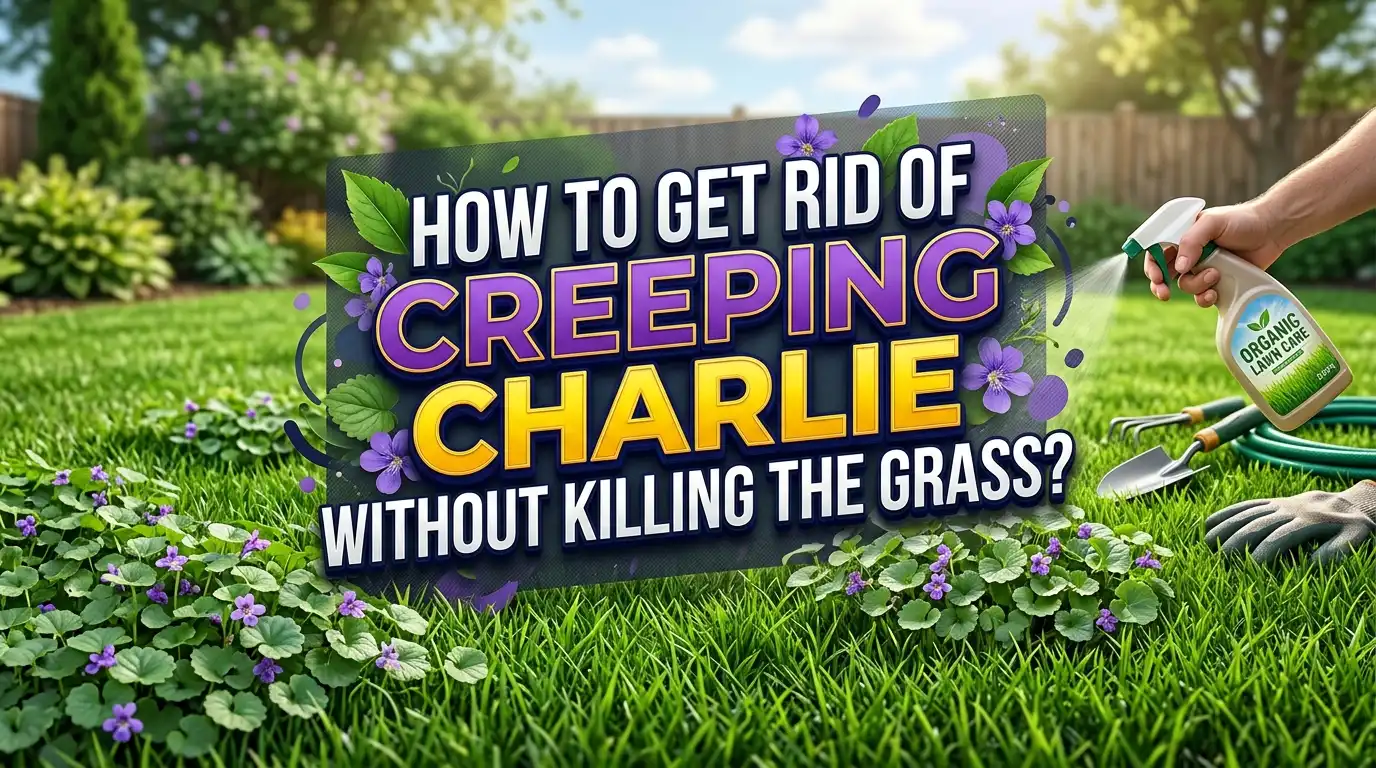
How to Get Rid of Creeping Charlie Without Killing the Grass?
You step outside on a beautiful spring morning, coffee in hand, and notice something has taken over your lawn. A low, creeping vine with round, scalloped leaves and tiny purple flowers has formed a thick mat right through your grass.
That uninvited guest is Creeping Charlie, also known as ground ivy (Glechoma hederacea), and it is one of the most stubborn weeds a homeowner can face.
So is there a way to remove this invasive weed while keeping your lawn green and intact? The answer is yes, and you have several options.
This guide walks you through proven methods, from hand pulling to selective herbicides to natural home remedies. Each method is explained step by step so you can choose the right approach for your lawn size, budget, and comfort level.
In a Nutshell
- Creeping Charlie is a perennial broadleaf weed that spreads through stolons (creeping stems) and can regrow from even a small piece of stem left in the soil. Removing it requires patience and consistency, no matter which method you choose.
- Hand pulling works best for small patches, but you must remove every root and stem fragment. This is the safest option for your grass, though it demands time and effort.
- Selective broadleaf herbicides containing triclopyr or 2,4 D are the most effective chemical solutions. These target broadleaf weeds and leave grass unharmed when applied according to label directions.
- The borax method is a popular natural alternative, but it must be applied with extreme precision. Too much boron will poison the soil and kill your grass along with the weed.
- Fall is the best season to treat Creeping Charlie with herbicides. The plant naturally moves nutrients from its leaves down to its roots at this time, carrying the herbicide deeper into its system for a more complete kill.
- Long term prevention depends on a thick, healthy lawn. Regular mowing at 3 to 4 inches, proper fertilization, overseeding thin spots, and improving drainage will crowd out Creeping Charlie and keep it from returning.
What Is Creeping Charlie and Why Is It So Hard to Kill
Creeping Charlie (Glechoma hederacea) is a perennial broadleaf weed in the mint family. It originally came from Europe and has spread across much of North America.
The plant produces round or kidney shaped leaves with scalloped edges, and it blooms with small funnel shaped lavender flowers in spring.
What makes Creeping Charlie so difficult to control is its aggressive spreading habit. The plant grows along the ground on creeping stems called stolons.
At every leaf node where a stem touches the soil, new roots form. This means a single plant can quickly create a dense, carpet like mat that chokes out grass.
Even tiny pieces of stem left behind can regenerate into a new plant. This is why pulling it out carelessly often makes the problem worse. If you snap off the runners without removing the root nodes, you may end up with several new plants instead of one.
The weed also thrives in conditions that stress your grass, including shade, moist soil, and poor drainage. It fills in wherever your turf is thin or weak, making it look like it appeared overnight.
Understanding this growth habit is the first step in beating it. You are not fighting a single weed. You are fighting a connected network of stems and roots that acts almost like one living organism. Every approach you take must account for this.
How to Identify Creeping Charlie in Your Lawn
Before you treat any weed, you need to confirm what you are dealing with. Creeping Charlie is sometimes confused with other ground covering plants like henbit, wild violet, or even clover. Correct identification saves you from wasting time and money on the wrong treatment.
Look for these key features. The leaves are round to kidney shaped with scalloped or rounded teeth along the edges. They grow opposite each other on square stems, which is a trait shared by all plants in the mint family. When you crush the leaves, they release a mild minty scent.
In spring, Creeping Charlie produces small, tubular, bluish purple flowers that appear in clusters at the leaf joints. The flowers bloom from April through June in most regions. The plant stays green throughout much of the year, even into late fall and early winter, which helps it outcompete dormant grass.
The growth pattern is another giveaway. Creeping Charlie hugs the ground closely and forms dense mats. Its stems root at every node where they contact soil. If you grab a section and pull, you will often lift a long, connected vine rather than an individual plant. Once you are confident in your identification, you can move on to choosing the right removal method.
Why You Should Act Quickly Against Creeping Charlie
Creeping Charlie does not wait around. The longer you let it grow, the harder it becomes to remove. A small patch in spring can become a full yard takeover by the end of summer. This weed spreads at a rate of 1 to 3 feet per season through its stolons alone.
Speed matters because of how the root network develops. Each node along a stolon produces its own root system. Over time, these roots anchor firmly into the soil and create a web of interconnected plants. What started as one vine becomes hundreds of rooted nodes, and each one can survive independently if the vine is broken.
Acting early also protects the health of your grass. Creeping Charlie competes directly with turf for sunlight, water, and soil nutrients. In shady areas where grass already struggles, Creeping Charlie can completely replace your lawn within a single growing season. Once it forms a thick mat, it shades the soil surface and prevents grass seed from germinating.
The takeaway is simple. If you spot Creeping Charlie in your lawn, start your chosen removal method right away. Waiting until next season gives the weed months of unchecked growth and makes every method less effective.
Hand Pulling: The Safest Method for Your Grass
Hand pulling is the most direct and grass safe way to remove Creeping Charlie. It requires no chemicals, poses zero risk to your turf, and works well for small to moderate infestations. The key is doing it correctly so you do not leave fragments behind.
Start by watering the area thoroughly the day before you plan to pull. Moist soil releases roots more easily than dry, compacted soil. Use a garden fork or hand cultivator to loosen the soil around the edges of the infestation before you start pulling.
Grab the vines as close to the base as possible and pull slowly and steadily. Follow each runner to its full length and pull out the entire connected stem. Do not yank quickly, as this breaks the stems and leaves rooted nodes behind. Place all pulled material in a bag or bin rather than tossing it on the ground, because even small pieces can re root.
After pulling, check the area weekly for any regrowth and pull new shoots immediately. It typically takes multiple sessions over a full growing season to clear an area completely.
Pros: No chemicals needed, zero risk to grass, free to do, works well for small areas.
Cons: Extremely labor intensive, time consuming for large areas, requires repeated sessions, easy to miss fragments that regrow.
Using Selective Broadleaf Herbicides Safely
Selective broadleaf herbicides are the most effective option for eliminating Creeping Charlie from a lawn without harming the grass. These products target broadleaf plants while leaving grass species untouched. The active ingredients you want to look for are triclopyr, 2,4 D, and dicamba.
Triclopyr is considered the most effective single ingredient against Creeping Charlie. Many lawn care professionals recommend products that combine triclopyr with 2,4 D for maximum impact. The combination attacks the weed through multiple pathways, giving it less chance to survive.
To apply, mix the herbicide according to the label instructions. Use a pump sprayer for spot treatments on smaller patches. For larger infestations, a hose end sprayer provides more even coverage. Always add a surfactant (a few drops of dish soap will work) to help the herbicide stick to the waxy leaves of Creeping Charlie. Without a surfactant, the spray tends to bead up and roll off.
Apply on a calm, dry day when temperatures are between 60 and 80 degrees Fahrenheit. Avoid spraying when rain is expected within 24 hours. Two to three applications spaced two to three weeks apart are usually needed for full control.
Pros: Highly effective, kills Creeping Charlie without harming grass, available at most garden centers, treats large areas efficiently.
Cons: Involves chemical use, requires careful label reading, multiple applications often needed, can harm desirable broadleaf plants like flowers and clover if spray drifts.
The Best Time of Year to Treat Creeping Charlie
Timing your treatment can make or break your results. Fall is widely considered the best time to apply herbicides to Creeping Charlie. University extension programs across the Midwest consistently recommend fall applications, and there is a good reason for this.
In autumn, perennial plants like Creeping Charlie begin pulling sugars and nutrients from their leaves down into their root systems. This process prepares the plant to survive winter.
When you apply a systemic herbicide during this period, the plant’s own transport system carries the chemical deep into the roots. This delivers a far more complete kill than a spring or summer application, which primarily affects the leaves.
The ideal fall window is from mid September through mid October in most northern climates. The plant should still be actively growing with green leaves, but nighttime temperatures should be dropping into the 40s and 50s.
Spring is your second best option. Apply herbicides when Creeping Charlie is actively growing and flowering, usually in late April through May. Avoid treating during the heat of summer, as both the weed and your grass are stressed, and herbicide effectiveness drops.
If you choose hand pulling or smothering methods, you can start those in spring as soon as the ground is soft enough to work.
The Borax Method: A Natural Alternative
The borax method has gained popularity as a chemical free alternative for controlling Creeping Charlie. It works because Creeping Charlie is more sensitive to the element boron than most lawn grasses. By applying a precise amount of borax (which contains boron), you can damage the weed while your grass survives.
The standard recipe calls for dissolving 10 ounces of borax in 4 ounces of warm water. Once dissolved, dilute this concentrate into 2.5 gallons of water. This amount treats approximately 1,000 square feet of lawn. Apply the solution evenly using a pump sprayer, and do not overlap your spray pattern.
The critical point is precision. There is a very thin margin between the amount of boron that kills Creeping Charlie and the amount that kills your grass. Boron does not break down easily in soil. It accumulates over time, so repeated or heavy applications can create toxic “hot spots” where nothing will grow for months or even years.
Iowa State University extension programs have noted that while borax can reduce Creeping Charlie infestations, results are inconsistent and depend on weather conditions. They generally do not recommend this method due to the risk of soil toxicity.
Pros: Uses a common household product, no synthetic chemicals, low cost, easy to prepare.
Cons: Narrow margin of safety, boron accumulates in soil, inconsistent results, risk of killing grass and other plants if overapplied, not recommended by many university extension programs.
Smothering Creeping Charlie With Landscape Fabric or Cardboard
If you have a section of lawn that is completely overrun, smothering can eliminate Creeping Charlie without any chemicals. This method blocks sunlight and air from reaching the plant, killing it over a period of several weeks.
Cover the infested area with heavy black plastic sheeting, thick cardboard, or multiple layers of newspaper. Anchor the covering with rocks, bricks, or landscape staples. Make sure the edges extend at least 6 inches beyond the visible boundary of the Creeping Charlie to catch any hidden runners.
Leave the covering in place for at least 6 to 8 weeks during warm weather. Heat builds up under the material, and the combination of darkness and heat kills the plant and its root nodes. Check periodically by lifting a corner. The Creeping Charlie should be brown and dead before you remove the covering.
After removing the covering, rake away the dead material and prepare the bare soil for reseeding. Add a thin layer of compost, spread grass seed, and keep the area moist until the new grass establishes. This step is essential because bare soil invites weeds to return.
Pros: No chemicals, kills all Creeping Charlie in the treated area, effective for heavily infested zones, low cost.
Cons: Kills everything under the covering including grass, requires reseeding, takes weeks to complete, not practical for scattered patches throughout the lawn, unsightly during treatment.
Improving Lawn Health to Outcompete Creeping Charlie
A thick, vigorous lawn is the best long term defense against Creeping Charlie. This weed exploits thin, weak, or stressed turf. If you remove the Creeping Charlie but do not address the conditions that allowed it to thrive, it will come back.
Mow your grass at the right height. Most cool season grasses should be kept at 3 to 4 inches. Taller grass shades the soil surface, which makes it harder for Creeping Charlie seeds and runners to take hold. Cutting your lawn too short weakens the grass and opens the door for weed invasion.
Fertilize your lawn on a regular schedule. A well fed lawn grows thicker and leaves fewer bare spots for weeds. Follow a fertilization plan appropriate for your grass type and climate, and test your soil every few years to identify any nutrient deficiencies.
Water deeply but less often. Creeping Charlie loves consistently moist soil. Watering deeply once or twice a week encourages your grass to develop deep roots, while frequent shallow watering keeps the soil surface moist and favors the weed. Improve drainage in areas where water tends to pool by aerating the soil or adding organic matter.
Overseed thin or bare patches as soon as they appear. Bare soil is an open invitation for Creeping Charlie. By filling those gaps with grass seed, you deny the weed its entry point.
Dealing With Creeping Charlie in Shady Areas
Shade is Creeping Charlie’s favorite environment. It thrives under trees, along fences, and on the north side of buildings where grass often struggles. Removing Creeping Charlie from shady spots requires a slightly different strategy than treating sunny areas.
First, accept that some areas may not support a traditional lawn. If a spot receives less than 3 to 4 hours of direct sunlight per day, even shade tolerant grass varieties will have difficulty competing with Creeping Charlie. In these areas, consider planting a shade loving ground cover that can outcompete the weed, such as pachysandra, vinca minor, or sweet woodruff.
If you want to keep grass in partial shade, choose shade tolerant grass varieties like fine fescue for cool season climates. These varieties are better adapted to low light conditions and form denser stands that resist weed invasion.
Prune tree branches to increase sunlight reaching the ground. Even raising the canopy by a few feet can make a significant difference. More light means stronger grass growth, which means less room for Creeping Charlie.
In shady areas where herbicides are needed, apply them at the same rates as sunny areas. Creeping Charlie growing in shade is just as susceptible to broadleaf herbicides. However, recovering grass may take longer to fill in bare spots after treatment, so overseeding and light fertilization are especially important in these zones.
Using Vinegar as a Spot Treatment
Vinegar is often mentioned as a natural weed killer, and it can work on Creeping Charlie in limited situations. The acetic acid in vinegar burns the leaves and stems on contact, causing them to wither and die. However, there are important limitations you need to understand before reaching for the spray bottle.
Standard household vinegar contains about 5% acetic acid. This concentration can burn the foliage of Creeping Charlie, but it typically does not kill the roots. The plant will regrow from its root nodes within a week or two. For better results, horticultural vinegar with 20% acetic acid is available, but it is much more potent and can cause skin burns and eye damage if not handled carefully.
Vinegar is non selective. It burns any plant tissue it contacts, including your grass. For this reason, it should only be used as a precise spot treatment, not a broadcast spray. Mix 2 parts vinegar to 1 part water in a spray bottle and apply directly to the Creeping Charlie leaves on a sunny day. The sun intensifies the burning effect.
Expect to apply multiple times over several weeks. Each application kills the visible growth, forcing the plant to use energy regrowing from its roots. Over time, this can weaken the weed enough to allow your grass to reclaim the area.
Pros: Readily available, inexpensive, no synthetic chemicals, works as a quick knockdown of visible growth.
Cons: Does not kill roots, requires many repeated applications, kills grass on contact if spray drifts, slow to produce lasting results, horticultural strength vinegar can be hazardous.
How to Prevent Creeping Charlie From Returning
Removing Creeping Charlie is only half the battle. Prevention is what keeps your lawn free of this weed long term. Without a proactive plan, the weed will return from surviving root fragments, neighboring yards, or seed spread.
Maintain a dense, healthy lawn as your first line of defense. Follow a consistent mowing schedule, fertilize appropriately, water deeply, and overseed thin spots. A thick stand of grass is the single most effective barrier against Creeping Charlie reinvasion.
Monitor your lawn every few weeks during the growing season. Walk the yard and look for the telltale round, scalloped leaves. Catching a new Creeping Charlie shoot when it is small means you can hand pull it in seconds. Ignoring it means another full scale treatment later.
Address soil compaction by aerating your lawn annually. Compacted soil weakens grass roots and holds excess moisture at the surface, both of which favor Creeping Charlie. Core aeration in fall improves drainage and helps grass roots grow deeper and stronger.
Keep an eye on neighboring properties. Creeping Charlie does not respect property lines. Its runners can spread from a neighbor’s yard into yours. If you share a border with an infested area, consider creating a physical barrier like an edging strip or maintaining a strip of dense, healthy grass along the boundary.
Finally, avoid leaving bare soil exposed for extended periods. After any lawn repair, construction, or garden project, reseed or cover the exposed ground as quickly as possible.
Common Mistakes to Avoid During Creeping Charlie Removal
Many homeowners make errors that make their Creeping Charlie problem worse instead of better. Knowing these pitfalls in advance saves you time, money, and frustration.
Mistake number one: using a non selective herbicide like glyphosate on the lawn. Glyphosate kills everything it touches, including your grass. It is useful for clearing an entire area before reseeding, but it is not a surgical tool for removing weeds from an existing lawn. Always use a selective broadleaf herbicide if you want to preserve your turf.
Mistake number two: pulling Creeping Charlie too quickly. Fast, aggressive pulling snaps the runners and leaves rooted nodes in the soil. Each fragment becomes a new plant. Slow, deliberate pulling with a loosened soil surface yields much better results.
Mistake number three: applying herbicides at the wrong time. Spraying during the heat of summer or when the plant is dormant wastes product and delivers poor results. Stick to fall as your primary treatment window and spring as your secondary option.
Mistake number four: skipping the surfactant. Creeping Charlie has waxy leaves that repel water based sprays. Without a surfactant to help the herbicide cling to the leaf surface, much of your spray ends up on the ground where it does no good.
Mistake number five: treating once and assuming the job is done. Creeping Charlie almost always requires two to three herbicide applications or multiple hand pulling sessions over a full season. One treatment rarely provides complete control.
A Season by Season Action Plan
Having a clear schedule keeps you on track and prevents Creeping Charlie from gaining the upper hand. Here is a practical timeline you can follow throughout the year.
Early Spring (March through April): Scout your lawn for Creeping Charlie as soon as the ground thaws. Mark infested areas. Begin hand pulling small patches. Do not apply herbicides yet, as the plant is just waking up and herbicide uptake will be low.
Late Spring (May through June): This is a good time for your first herbicide application if the infestation is large. Creeping Charlie is actively growing and flowering, which means it is absorbing nutrients and will take in herbicide effectively. Apply a selective broadleaf herbicide with a surfactant on a calm, dry day.
Summer (July through August): Focus on lawn health. Water deeply, mow at the correct height, and avoid stressing your grass. Monitor for Creeping Charlie regrowth and hand pull any new shoots. Avoid herbicide applications during extreme heat.
Fall (September through October): This is your most important treatment window. Apply a selective broadleaf herbicide containing triclopyr or a triclopyr and 2,4 D combination. The plant is moving nutrients to its roots, and the herbicide will follow. Apply a second treatment two to three weeks after the first if needed.
Late Fall (November): Overseed any bare spots left by dead Creeping Charlie. Apply a winterizer fertilizer to strengthen your grass going into dormancy.
Frequently Asked Questions
Does Creeping Charlie Die on Its Own in Winter?
No. Creeping Charlie is a perennial weed that can remain green even through light frosts. It goes semi dormant in cold winters but comes back strong in spring. The plant does not die off seasonally like annual weeds. If you do not actively remove it, Creeping Charlie will persist year after year and continue to spread each growing season.
Will Mowing Kill Creeping Charlie?
Mowing alone will not kill Creeping Charlie. The plant grows flat against the ground, often below the height of your mower blade. Regular mowing can trim its upright stems and flowers, but it does not damage the runners or root nodes. Mowing is an important part of overall lawn health, which indirectly helps suppress Creeping Charlie, but it must be combined with direct removal methods for actual control.
Is Creeping Charlie Harmful to Pets or Children?
Creeping Charlie itself is not considered toxic to dogs, cats, or humans. However, if you apply herbicides or borax to treat the weed, those substances can pose health risks. Keep children and pets off treated areas until the product has dried completely, and follow all safety guidelines on the herbicide label. Horticultural vinegar can also cause skin irritation and should be stored safely.
Can I Just Let Creeping Charlie Take Over Instead of Grass?
Some homeowners choose to embrace Creeping Charlie as a ground cover, and it does have a few benefits. It stays green, tolerates shade, controls erosion, and produces flowers that attract pollinators. However, it does not tolerate foot traffic well and can spread aggressively into garden beds and neighboring properties. If you decide to keep it, you will need to manage its spread at the borders.
How Long Does It Take to Fully Eliminate Creeping Charlie?
Complete removal typically takes one to two full growing seasons with consistent effort. A single herbicide application may kill 70 to 80 percent of the visible weed, but surviving root nodes will send up new growth. Plan for at least two to three herbicide treatments in fall, followed by additional spot treatments the following spring. Hand pulling alone may take even longer, depending on the size of the infestation.
Will Overseeding Help After Removing Creeping Charlie?
Yes. Overseeding is one of the most important steps after removing Creeping Charlie. Dead weed material leaves bare patches that are perfect for new weed seeds to colonize. By spreading grass seed into these bare spots immediately after removal, you fill the gaps with desirable turf and deny Creeping Charlie a foothold for return. Choose a grass variety suited to the sun exposure and soil conditions of the treated area for the best results.

Hi, I’m Jane! As a passionate gardener and product enthusiast, I spend my days testing garden tools, comparing products, and writing honest reviews so you don’t have to learn the hard way. Got a question? Feel free to reach out — I’d love to hear from you!