How to Fix a Spongy Thatch Layer Underneath Zoysia Grass?
You walk across your zoysia lawn and notice something odd. The ground feels soft, bouncy, and almost like a mattress. Your feet sink slightly with every step. That spongy sensation is a telltale sign that a thick thatch layer has built up underneath your grass. Left unchecked, this problem will choke out your turf, invite disease, and turn your once beautiful lawn into a patchy eyesore.
Zoysia grass is a favorite for warm climate lawns because of its dense growth, drought resistance, and ability to handle foot traffic. But that same dense growth habit is also its biggest weakness. Zoysia produces a thick web of stems, stolons, and rhizomes that decompose very slowly.
The good news? You can absolutely fix this problem. This guide walks you through every practical step you need to take, from identifying how bad the thatch is to removing it, preventing it from coming back, and restoring your lawn to full health.
In a Nutshell
- Thatch is a layer of dead and living organic material that sits between the soil surface and the green grass blades. Zoysia grass is especially prone to thatch buildup because its tough, fibrous stems and stolons resist decomposition. A healthy thatch layer should be half an inch or less. Anything thicker starts causing real problems.
- A spongy feel underfoot is the clearest sign that your thatch has grown too thick. You may also notice water pooling on the surface after irrigation, uneven mowing, or brown patches caused by fungal disease living in the moist thatch layer.
- The primary fix involves mechanical removal through dethatching or vertical mowing, combined with core aeration to break up the compacted layer and encourage microbial activity. These tasks should be done during the active growing season, typically late spring through early summer, so the grass recovers quickly.
- Prevention is just as important as the cure. Adjusting your fertilization, watering, and mowing habits will slow future thatch production. Topdressing with compost or sand after dethatching introduces beneficial microorganisms that help break down organic matter naturally.
- Severe thatch problems over one inch thick should be addressed gradually over two to three seasons rather than all at once. Removing too much thatch in a single pass will thin the turf and leave it vulnerable to weeds, drought stress, and further damage.
What Exactly Is a Thatch Layer in Zoysia Grass
Thatch is a tightly woven mat of dead roots, stems, stolons, and rhizomes that collects between the soil and the green, actively growing grass. It forms naturally in every lawn, but some grass types produce it faster than others.
Zoysia grass is a heavy thatch producer. Its stems contain high levels of a compound called lignin, which resists breakdown by soil microorganisms. Unlike leaf clippings, which decompose quickly, these tough stem fibers linger in the lawn for months or even years. The dense growth habit of zoysia adds to the problem. Each plant sends out a network of underground rhizomes and above ground stolons, all of which contribute organic material to the thatch layer.
A thin layer of thatch, about half an inch or less, is actually beneficial. It insulates roots from heat and cold, retains some soil moisture, and provides a cushion against foot traffic. The trouble starts when that layer exceeds half an inch. At that point, it acts as a barrier that blocks water, air, and nutrients from reaching the soil. Roots begin growing into the thatch instead of the soil, making the entire lawn weaker and more vulnerable to stress.
Understanding that thatch is not simply “dead grass on top of the lawn” helps you treat the problem correctly. It is a structural issue below the visible surface, and it requires specific mechanical and cultural solutions.
How to Tell If Your Thatch Layer Is Too Thick
The spongy feel is the first and most obvious clue. If your lawn feels like you are walking on a trampoline or foam pad, you likely have a thatch problem. But you should confirm the thickness before taking action.
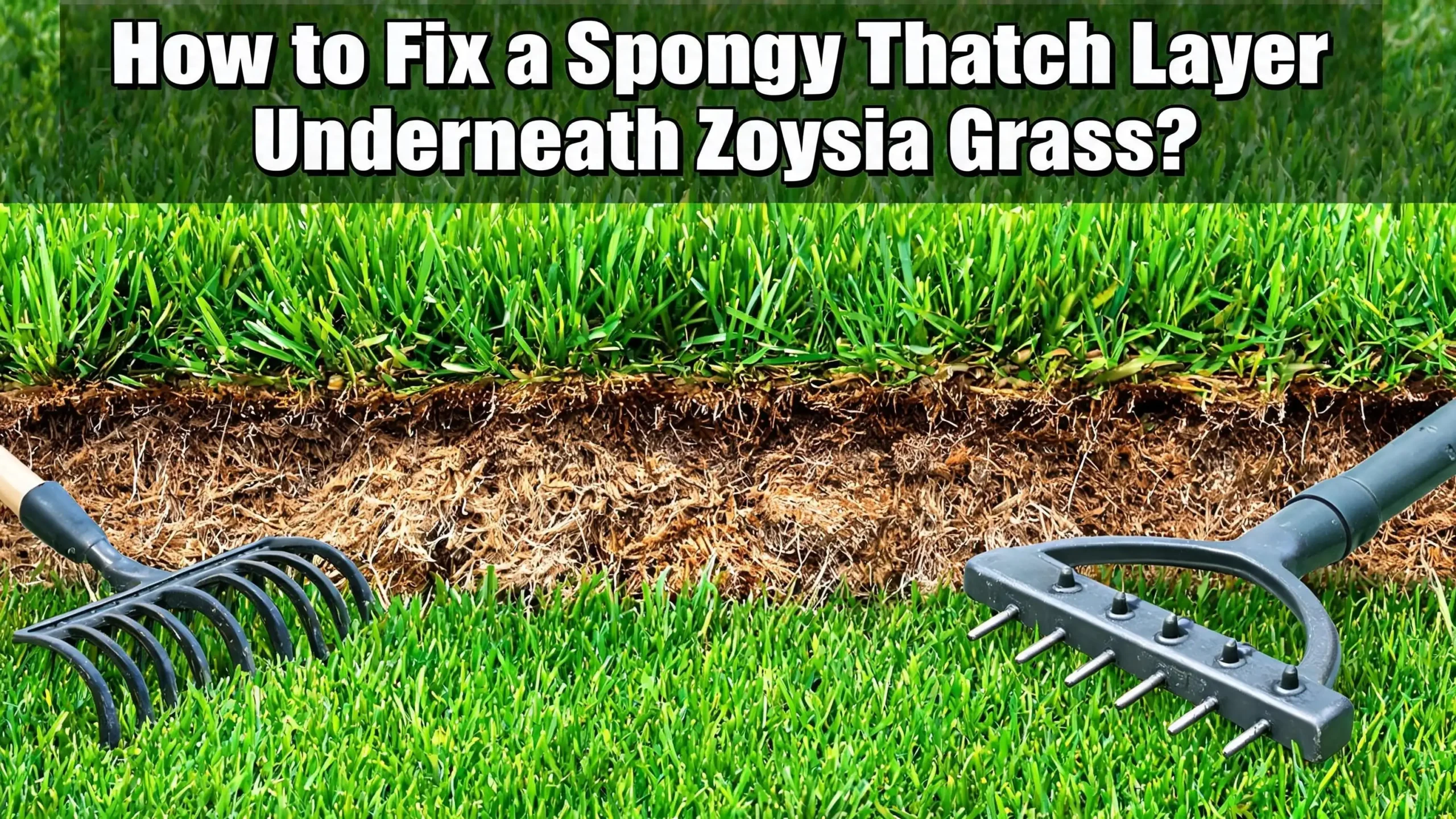
Grab a screwdriver, knife, or small garden trowel and push it into the lawn. Cut a small wedge of turf about three inches deep. Pull it up and look at the cross section. You will see three distinct layers: the green grass blades on top, a brown fibrous layer in the middle, and soil at the bottom. That brown layer is your thatch.
Measure it. If the thatch is half an inch or less, your lawn is healthy and you do not need to dethatch. If it measures between half an inch and one inch, you should plan for dethatching during the next active growing season. If the thatch exceeds one inch, you have a serious buildup that requires a more gradual, multi season approach.
Other signs of excessive thatch include water sitting on the surface after rain or irrigation, increased fungal disease like large brown patch, and areas where the mower scalps the lawn because the wheels sink into the soft surface. Pay attention to these warning signs before the problem becomes severe.
Why Zoysia Grass Builds Thatch Faster Than Other Grasses
Zoysia’s aggressive spreading habit is both its greatest strength and the root cause of thatch buildup. This grass spreads through both stolons (above ground runners) and rhizomes (below ground runners), creating an incredibly dense turf. All that growth generates a large amount of organic matter.
The stem tissue of zoysia grass is coarse and rigid. It contains more lignin than many other turf species. Lignin is extremely resistant to microbial decomposition. While leaf clippings break down in a matter of weeks, zoysia stems can persist in the thatch layer for years. This slow decomposition rate means organic debris accumulates faster than it disappears.
Soil conditions also play a role. Acidic soils with a pH below 5.5 tend to suppress the microbial populations responsible for breaking down organic matter. Compacted clay soils and sandy soils with low organic content also lack sufficient microbial activity. If your soil falls into any of these categories, thatch will build up even faster.
Over fertilizing with nitrogen accelerates the problem further. Nitrogen pushes rapid top growth and increases the production of stems and roots, all of which feed the thatch layer. Combined with frequent shallow watering, this creates the perfect recipe for a thick, spongy lawn.
The Best Time to Dethatch Zoysia Grass
Timing is critical. Dethatching is a stressful process for the turf. The grass needs to be in its peak growing phase to recover quickly from the damage.
For zoysia grass, the ideal window is late spring through early summer, roughly from late May through June in most warm climate regions. At this point, the grass has fully broken dormancy, is actively growing, and has the longest recovery period ahead of it before fall dormancy. Soil temperatures should be consistently above 70 degrees Fahrenheit.
Some lawn care professionals also dethatch in late summer around early August, but this leaves a shorter recovery window. Avoid dethatching in fall, winter, or early spring. The grass is either dormant or just beginning to green up during those times, and the stress from dethatching can cause significant thinning and weed invasion.
If your thatch exceeds one inch, do not try to remove it all in a single session. Plan to remove a portion during the late spring window and address the rest the following season. Gradual removal over two to three years protects the turf and produces much better long term results.
Water your lawn deeply the day before you plan to dethatch. Moist soil softens the thatch and makes the entire process easier and less damaging.
How to Dethatch Zoysia Grass with a Power Rake
A power rake, also called a power dethatcher, is one of the most effective tools for removing thatch from zoysia lawns. It uses rotating tines or flails that slice into the thatch layer and pull it up to the surface.
Start by mowing your zoysia lower than normal, bringing it down to about one inch or slightly below. This exposes more of the thatch layer and gives the power rake better access. Bag the clippings so the dethatching surface is clear.
Set the power rake blades to a shallow depth for your first pass. Zoysia is sensitive, and cutting too deep on the first attempt can rip out live stolons and thin the turf. Run the machine in one direction across the lawn, then assess the results. If significant thatch remains, make a second pass at a slightly deeper setting or in a perpendicular direction.
Rake up all the debris that the power rake brings to the surface. You will likely be surprised at the volume of material pulled out. Bag it or add it to your compost pile.
After dethatching, the lawn will look rough and thin. This is completely normal. Follow up immediately with a thorough watering and a light application of fertilizer to encourage rapid regrowth. Within three to four weeks, the zoysia should fill back in.
Using a Vertical Mower for Severe Thatch Problems
For thatch layers exceeding one inch, a vertical mower (also called a verticutter) provides more precise and powerful thatch removal than a standard power rake. Vertical mowers use rigid steel blades that slice perpendicular to the turf surface, cutting through the thatch at controlled depths.
The key advantage of a vertical mower is adjustability. You can set the blade spacing and cutting depth independently. For zoysia grass, start with blades spaced about one to two inches apart and set the depth to cut only into the upper portion of the thatch. A conservative first pass prevents excessive turf damage.
After the first pass, inspect the lawn and measure the remaining thatch. If it is still too thick, you can make a second pass at a deeper setting or perpendicular to the first direction. Collect all debris between passes so you can clearly see the results.
Vertical mowing causes more stress than power raking, so recovery time is slightly longer. Give the lawn at least four to six weeks of active growing conditions before performing any additional aggressive treatments. Fertilize lightly and keep the soil consistently moist but not waterlogged during the recovery period.
For extremely thick thatch, plan to vertical mow once per season over two to three consecutive years. This staged approach minimizes turf loss and allows the grass to recover fully between treatments.
Why Core Aeration Is Essential for Thatch Control
Core aeration is one of the most valuable tools for managing thatch in zoysia lawns. An aerator pulls small plugs of soil out of the ground, typically two to three inches deep. These plugs contain soil microorganisms that, once deposited on the surface, mix with the thatch and accelerate its decomposition.
The holes left behind reduce soil compaction and allow water, air, and nutrients to penetrate directly into the root zone. Improved oxygen levels in the soil boost microbial populations that break down thatch. Over time, regular aeration can significantly slow the rate at which thatch accumulates.
Core aeration also causes less surface damage than power raking or vertical mowing. For lawns with moderate thatch buildup (half an inch to three quarters of an inch), aeration alone may be sufficient to bring the thatch layer under control, especially when combined with proper cultural practices.
Aerate your zoysia lawn during the same late spring to early summer window recommended for dethatching. Make two passes over the lawn in perpendicular directions for maximum coverage. Leave the soil plugs on the surface. They will break down within a few weeks and naturally filter back into the thatch, introducing decomposing organisms exactly where they are needed.
For best results, combine aeration with topdressing. The combination is far more effective than either practice alone.
How Topdressing Helps Break Down Thatch Naturally
Topdressing involves spreading a thin layer of material, usually compost, sand, or a blend of both, over the lawn surface. This simple practice has a powerful effect on thatch decomposition.
When you topdress after aerating, the material fills the aeration holes and settles into the thatch layer. Compost introduces millions of beneficial microorganisms directly into the zone where thatch accumulates. These microbes consume the organic debris and convert it into usable nutrients for the grass. Sand improves drainage and prevents moisture from getting trapped in the thatch layer, which further supports microbial activity.
Apply approximately a quarter inch of topdressing material per application. Spread it evenly with a shovel and then work it into the turf using the back of a rake or a drag mat. The goal is to get the material down into the thatch and aeration holes, not sitting on top of the grass blades.
Topdressing once or twice per year, especially after aeration, creates a steady cycle of thatch decomposition. Over several seasons, this approach can reduce thatch buildup significantly without the stress of aggressive mechanical removal. It is one of the most effective long term strategies for keeping zoysia lawns healthy.
Adjusting Your Fertilization Habits to Reduce Thatch
Over fertilizing is one of the leading causes of excessive thatch in zoysia grass. Too much nitrogen pushes rapid stem, stolon, and root production, all of which feed directly into the thatch layer.
Zoysia grass requires far less fertilizer than most homeowners think. University extension research recommends about two pounds of nitrogen per 1,000 square feet per year for established zoysia lawns. Spread this over two to three applications between May and August. Avoid fertilizing in early spring when the grass is just greening up, and never fertilize during dormancy.
Choose slow release nitrogen fertilizers over fast release options. Slow release formulas feed the grass gradually, promoting steady growth without the explosive flushes that generate excess organic matter. Fast release fertilizers create a burst of top growth followed by a spike in thatch production.
Get your soil tested before applying any fertilizer. A soil test reveals your lawn’s exact nutrient needs and pH level. If your soil pH is below 6.0, apply lime to raise it. Slightly acidic to neutral soil (pH 6.0 to 7.0) supports the microbial populations that decompose thatch naturally. Correcting soil pH is one of the simplest and most overlooked steps in thatch management.
Proper Watering Practices That Prevent Thatch Buildup
Watering habits directly affect how quickly thatch accumulates in your zoysia lawn. Frequent, shallow watering encourages roots to stay near the surface and grow into the thatch layer instead of reaching down into the soil. This weakens the turf and adds more root material to the thatch.
Zoysia grass is drought tolerant and needs less water than many other turf types. Water deeply but infrequently, applying about one inch of water per session. Allow the soil to dry out slightly between waterings. This forces roots to grow deeper into the soil in search of moisture, creating a stronger root system that is less dependent on the thatch layer.
In most climates, zoysia lawns need watering only once or twice per week during the growing season. During cooler months or rainy periods, you may not need to water at all. Over watering also creates a consistently moist thatch layer, which encourages fungal diseases like large brown patch, a common problem in zoysia grass.
Monitor your lawn after rain and irrigation. If water sits on the surface for more than a few minutes, that is a sign the thatch is blocking penetration and you need to take action with aeration or dethatching.
Mowing Strategies That Keep Thatch in Check
Consistent, proper mowing is a free and effective tool for managing thatch in zoysia grass. The right mowing habits reduce the amount of organic material that feeds the thatch layer.
Mow your zoysia at a height of one to two inches, depending on the variety. Zeon and Emerald varieties perform well at one inch, while other cultivars do better slightly higher. The key rule is to never remove more than one third of the leaf blade in a single mowing. Cutting too aggressively stresses the grass and forces it to produce more stem tissue as it recovers, which adds to thatch.
Mow frequently enough to maintain the one third rule. During peak growing season in summer, this may mean mowing every five to seven days. Skipping mowing sessions and then scalping the lawn to catch up is one of the worst things you can do for thatch management.
Leave clippings on the lawn unless they form visible clumps. Research shows that grass clippings do not contribute significantly to thatch. They decompose quickly and return nutrients to the soil. However, if a thick thatch layer already exists, clippings may sit on top of the thatch without breaking down. In that case, bag them until you have addressed the underlying thatch problem.
Spring Scalping: A Powerful Annual Reset for Zoysia
Many experienced zoysia growers perform a spring scalping as part of their annual maintenance routine. This involves lowering the mower to its lowest safe setting and cutting the dormant, brown zoysia down to the soil level in late winter or very early spring, just before green up begins.
Scalping removes the dead top growth that would otherwise add to the thatch layer. It also exposes the soil to sunlight, which warms the ground faster and promotes earlier green up. For lawns with moderate thatch buildup, a spring scalp can remove a meaningful amount of surface material without the need for a full dethatching operation.
After scalping, bag and remove all the clippings. Leaving that volume of dead material on the lawn will smother new growth and slow recovery. Once the debris is cleared, the lawn is also in an ideal condition for overseeding thin areas, applying pre emergent herbicide, or topdressing.
Keep in mind that scalping is only appropriate on dormant zoysia. If the grass has already started to green up, scalping will damage new growth and set the lawn back several weeks. Watch for the first signs of green color at the base of the plants and time your scalp just before that occurs.
Boosting Soil Biology to Fight Thatch From Below
Healthy soil is your best long term defense against thatch. Soil microorganisms, earthworms, and fungi are responsible for breaking down organic matter in the thatch layer. If these populations are low, thatch will accumulate regardless of how carefully you manage the lawn above ground.
Compost topdressing is the most direct way to introduce beneficial microbes. Applying a thin layer of quality compost once or twice a year feeds the existing microbial community and introduces new organisms that specialize in decomposing tough plant fibers like lignin and cellulose.
Avoid practices that harm soil biology. Over applying pesticides, especially certain insecticides, can reduce earthworm populations significantly. Earthworms are some of the most effective thatch decomposers because they physically mix soil with organic material as they burrow, creating conditions that accelerate microbial breakdown.
Maintain a soil pH between 6.0 and 7.0 to support a diverse microbial community. Acidic soils below 5.5 suppress many beneficial bacteria and fungi. A simple lime application based on soil test results can dramatically improve conditions for thatch decomposition.
Healthy soil biology works slowly but continuously. Over two to three seasons of proper management, you will notice the thatch layer thinning naturally as microbial activity catches up to organic matter production.
How to Recover Your Lawn After Dethatching
Dethatching leaves your zoysia lawn looking thin, rough, and somewhat beaten up. This is expected, and the recovery process is straightforward if you follow a few important steps.
Water the lawn thoroughly within hours of dethatching. The exposed soil and remaining grass plants need consistent moisture to begin the healing process. Keep the soil moist but not saturated for the first two to three weeks. Water lightly every day or every other day during this initial recovery phase.
Apply a light dose of balanced fertilizer to give the grass the nutrients it needs to push new growth. Avoid heavy nitrogen applications, which could cause the very problem you just worked to fix. A half rate application of a slow release fertilizer is ideal.
If the dethatching process has created bare or thin spots, consider plugging or sprigging zoysia into those areas. Zoysia recovers well from plugs because of its natural spreading habit. The new plugs will fill in over the course of the growing season.
Avoid heavy foot traffic on the lawn for at least three to four weeks after dethatching. The weakened turf is vulnerable to compaction and physical damage during recovery. Once new green growth is clearly established and the lawn begins to thicken, you can resume normal use.
Creating a Long Term Thatch Prevention Plan
Fixing a spongy thatch problem is only half the battle. Without a prevention plan, the thatch will return within a few years. A simple annual maintenance schedule keeps thatch under control and protects your investment.
Aerate your zoysia lawn once per year during the late spring to early summer active growth period. Annual aeration is the single most effective preventive measure against thatch buildup. It introduces soil microbes to the thatch layer, reduces compaction, and improves root health.
Topdress with compost or sand after aeration at least once per year. This enhances the benefits of aeration and feeds the soil biology responsible for natural thatch decomposition.
Follow a moderate fertilization program of no more than two pounds of nitrogen per 1,000 square feet per year. Use slow release formulas and apply them only during the active growing months of May through August. Get a soil test every two to three years to monitor pH and nutrient levels.
Mow consistently at the correct height and frequency. Perform a spring scalp each year to remove dormant top growth. Water deeply and infrequently to promote deep root growth and discourage thatch dwelling roots.
With this plan in place, your zoysia lawn will stay firm, green, and healthy for years to come. Consistency is the key. Small, regular maintenance steps prevent the kind of severe thatch buildup that requires aggressive and expensive correction.
Frequently Asked Questions
How thick should the thatch layer be on a zoysia lawn?
A healthy thatch layer on a zoysia lawn should be half an inch or less. This thin layer provides insulation against temperature swings, retains some soil moisture, and cushions the turf against foot traffic. Once the thatch exceeds half an inch, it begins to block water, air, and nutrients from reaching the soil. At one inch or more, you will notice a distinctly spongy feel underfoot and should take corrective action.
Can I dethatch zoysia grass in the fall?
Dethatching zoysia grass in the fall is not recommended in most climates. Zoysia is a warm season grass that enters dormancy as temperatures drop in autumn. Dethatching during this period leaves the turf unable to recover before winter. The ideal time to dethatch is late spring through early summer, when the grass is actively growing and has the full summer ahead to fill back in.
Will leaving grass clippings on my lawn cause thatch buildup?
Research from multiple university turf programs shows that grass clippings do not significantly contribute to thatch. Clippings are mostly water and soft tissue that decompose rapidly. The main components of thatch are stems, stolons, rhizomes, and root tissue, which are far tougher and slower to break down. You can safely leave clippings on your zoysia lawn unless a thick thatch layer is already preventing them from reaching the soil.
How often should I dethatch my zoysia lawn?
Most well maintained zoysia lawns need dethatching only every three to five years. If you follow a proper maintenance plan that includes annual aeration, moderate fertilization, and correct watering practices, you may rarely need to dethatch at all. Monitor your thatch layer at least once per year by pulling a small soil core and measuring the brown fibrous layer between the green grass and the soil.
Is it better to aerate or dethatch zoysia grass?
Both serve different purposes, but aeration is gentler and more preventive, while dethatching is a corrective measure for lawns with existing thick thatch. Core aeration breaks up compaction, introduces soil microbes to the thatch layer, and improves root health with minimal turf damage. Dethatching physically removes the built up organic material but causes more stress. For most zoysia lawns, annual aeration combined with topdressing is sufficient. Reserve dethatching for situations where the thatch has already exceeded half an inch.
Can I fix a severe thatch problem in one season?
If your thatch layer is over one inch thick, do not try to remove it all at once. Aggressive single session removal strips out live grass plants along with the thatch, leaving thin, bare areas vulnerable to weeds and erosion. Plan to address severe thatch over two to three growing seasons. Remove a portion each year through vertical mowing or power raking, and support recovery with aeration, topdressing, and proper fertilization between sessions.

Hi, I’m Jane! As a passionate gardener and product enthusiast, I spend my days testing garden tools, comparing products, and writing honest reviews so you don’t have to learn the hard way. Got a question? Feel free to reach out — I’d love to hear from you!